
Older ASICs and Thin Margins: Deciding When a Machine Still Pays
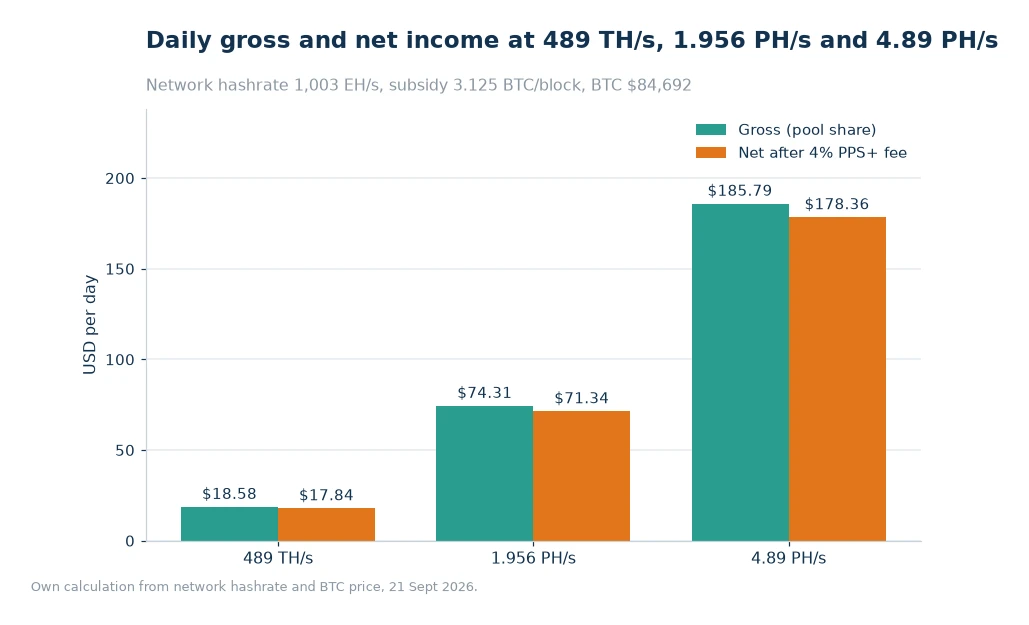
An older miner rarely dies; its margin does. A 489 TH/s machine earns 0.00021937 BTC a day at the 21 September 2026 reading, which is $18.58 gross and $17.84 net at the listed 4%. Whether that is worth running depends on a number the pool never asks about: joules per terahash.

Key takeaways
- 489 TH/s credits 0.00021937 BTC a day, or $18.58 gross and $17.84 net after the listed 4%.
- At 20 J/TH the machine draws 9.78 kW and burns 234.7 kWh a day, which is $14.08 at $0.06 per kWh.
- A 30 J/TH machine at the same hashrate needs 14.67 kW, turning a $3.76 daily margin into a loss.
- Difficulty and price move the margin, but efficiency decides whether a machine can survive the move.
Efficiency decides retirement, not age
Two machines can report identical hashrate and earn identical pool credits while one is worth running and the other is not. The difference is the wall draw. A unit at 20 J/TH consumes 9.78 kW at 489 TH/s; one at 30 J/TH consumes 14.67 kW for the same output. At a tariff of $0.06 per kWh the first costs $14.08 a day and the second $21.12, against the same $17.84 of net pool income.
That is the whole retirement argument in one line. The pool pays for hashrate, not for efficiency, so it cannot reward a newer machine directly. What a newer machine buys is a lower cost per unit of output, and that only matters because the output is fixed by the network. As difficulty rises, the output falls for everyone, but the machine with the lower draw has further to fall before it hits zero.
Age is a rough proxy for efficiency and a bad one in individual cases. A well-maintained older unit running cool can beat a newer unit that is throttling in a poorly ventilated room. Measure the wall draw, measure the reported hashrate over a day, and divide. That figure, not the purchase date, belongs in the decision.
The same hashrate under three tariffs
The table holds hashrate and pool income constant to show how much of the margin the site controls. Power figures assume 20 J/TH, which is a modern air-cooled unit and a reasonable benchmark for this comparison. Cooling load is not included, so a hot climate needs a further deduction.
| Tariff per kWh | Power cost per day | Margin after power | Share of net income |
|---|---|---|---|
| $0.04 | $9.39 | $8.45 | 47% |
| $0.06 | $14.08 | $3.76 | 21% |
| $0.08 | $18.78 | −$0.94 | −5% |
The step from four cents to eight cents wipes out the entire margin without touching the machine. This is why miners talk about tariffs before they talk about hardware, and why a move to a cheaper jurisdiction can revive a fleet that looked finished. It also explains why a hosting contract quoted per kilowatt-hour should be compared with the local tariff rather than with another host's headline fee.
Where the margin goes when difficulty moves
The next difficulty estimate in this reading was −2.12%, a small tailwind for existing machines. A rise of the same size would cut output per terahash by about 2%, or roughly 36 cents a day at 489 TH/s. Small on its own, but difficulty has a habit of moving in one direction over long periods, and a machine with a 21% margin has room for fewer such moves than one with a 47% margin.
Price is the faster variable in both directions. A 20% fall in BTC takes the gross from $18.58 to $14.86 and the net to $14.27, which at $0.06 per kWh leaves almost nothing. A 20% rise does the opposite. Neither move changes the joules, which is why efficiency is the part of the plan you can actually control.
All of this arithmetic assumes the PPS+ default, where the block-reward component settles hourly against current difficulty at a listed 4% and the transaction-fee component carries 2%. Switch to PPLNS and the long-run average shifts slightly while the shape of the credits changes a lot, which matters for a machine living on a narrow margin and paying a monthly bill.
There is a third variable that does not appear in any calculator: the resale value of the hardware. A machine that is marginal today may still be worth more to someone with cheaper power than it is to you, and that option value belongs in the retirement decision. Scrapping a unit that could be sold is a choice, not a necessity.
Worked example
- The chain issues 450 BTC a day (144 × 3.125).
- Against 1,003,000,000 TH/s, one TH/s gets 450 ÷ 1,003,000,000 = 0.0000004486 BTC.
- 489 TH/s: 489 × 0.0000004486 = 0.00021937 BTC a day.
- At $84,692: 0.00021937 × 84,692 = $18.58.
- Net of the listed 4%: 18.58 × 0.96 = $17.84.
- Power at 20 J/TH: 489 × 20 = 9,780 W; 9.78 kW × 24 = 234.7 kWh a day.
- At $0.06 per kWh: 234.7 × 0.06 = $14.08, leaving $3.76.
- At 30 J/TH the same machine needs 14.67 kW and 352.1 kWh, which is $21.12 a day and a $3.28 loss.
- 1.956 PH/s is 1,956 TH/s: 1,956 × 0.0000004486 = 0.00087746 BTC, or $74.31 gross and $71.34 net. At 4.89 PH/s, 4,890 × 0.0000004486 = 0.00219368 BTC, or $185.79 gross and $178.36 net.
When a machine still covers power
A unit with a positive margin after power has one clear job: keep running while the margin lasts. It also has a second, less obvious use as a test bed. Firmware changes, pool settings and cooling layouts can be tried on a machine whose loss would be small, then applied to the productive fleet once they prove out. That is cheaper than experimenting on the units that pay the bills.
Keep the accounting honest during this phase. A machine that nets $3.76 a day is not covering its own replacement, and pretending otherwise delays a decision. Note the margin per day, the estimated remaining life, and the resale price in the same place, so the comparison is between real numbers rather than between hope and a spreadsheet.
Using a ranking as a filter, not a scoreboard
A profitability table sorted by daily dollars puts the biggest machines at the top, which tells you nothing about whether one belongs in your room. Sort by efficiency instead, or filter by the power you can actually supply. The Miner Profitability Ranking shows current models against price and difficulty, and it is most useful when read as a list of options that fit your constraints rather than as a league table.
Two constraints do most of the filtering: the circuit capacity at the site and the tariff. A machine that needs 14.67 kW may be impossible on a domestic feed even if its margin looks fine at a commercial rate. Work backwards from the feed, then from the tariff, then compare models. The ViaBTC Mining Guide covers the pool side of the setup, which is the part that stays the same whichever machine you choose.
Frequently asked questions
At what power cost does 489 TH/s stop paying?
With net pool income of $17.84 a day at $84,692 and a 20 J/TH draw of 234.7 kWh, the break-even tariff is about $0.076 per kWh. Above that the machine costs more to run than it earns.
Is an older machine ever worth keeping?
Yes, if it still covers power at your tariff, if it can be sold for more than scrap, or if it is useful for testing changes before they reach the productive fleet. The decision is arithmetic plus resale value.
Does a higher hashrate make an inefficient machine viable?
Only in proportion. Doubling hashrate doubles both income and draw at the same efficiency, so the margin per unit of power stays the same. Lower joules per terahash is the only change that improves the ratio.
Run the efficiency test before the next purchase
Put a wattmeter on the machine, read the hashrate from the pool dashboard, and divide watts by terahashes. Compare that figure with the tariff and the current daily credit. The Profit Calculator will turn the hashrate into dollars at today's difficulty, and the wattmeter supplies the half of the equation the calculator cannot see.
Sources: ViaBTC's homepage, pricing page and miner ranking page, for scheme rules, the listed 4% rate and model comparisons[1]. Data read 21 Sept 2026: 1,003 EH/s network hashrate, 132.76 T difficulty, 3.125 BTC per block over 144 blocks, BTC $84,692. Unless stated, power is priced at $0.06 per kWh and machines draw 20 J/TH. Published 22 Oct 2026.